People Make Mathematics: Glasgow to host the International Congress of Mathematicians for the first time in 2030
The Scottish Event Campus (SEC) is set to welcome the world’s leading mathematicians in 2030, when Glasgow hosts the International Congress of Mathematicians (ICM) for the first time.
The Congress, which is held every four years and will see thousands of mathematicians and delegates from around the world gather in Glasgow, includes the presentation of the prestigious Fields Medal, which featured in the Oscar-winning movie ‘Good Will Hunting’.
Often described as the “Nobel Prize of Mathematics”, the Fields Medal is awarded to between two and four mathematicians under the age of 40 in recognition of outstanding mathematical achievement.
The prestigious accolade was a central reference point in the classic movie featuring Matt Damon which told the story of a mathematical genius hiding in plain-sight and received a slew of Oscar nominations in 1998.
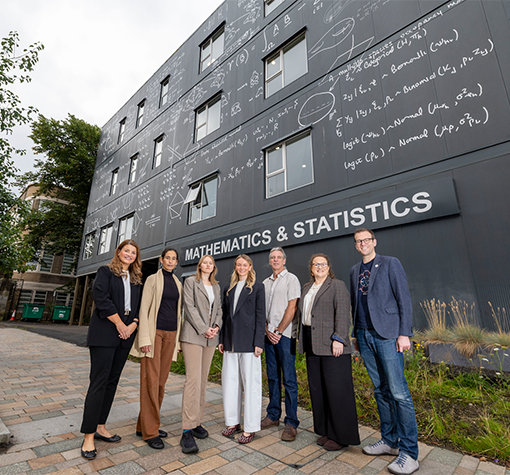
The successful bid to bring the ICM to Glasgow was supported by academics from the University of Glasgow, built around a broader and ambitious vision of accessibility, collaboration and global participation and the message: ‘People Make Mathematics.’ The bid also reflected the importance of mathematics in underpinning other fields such as computer science, medical imaging, engineering, and economics.
For the SEC, securing the Congress enhances its reputation as a destination for some of the world’s largest and most influential academic gatherings. The Campus recently hosted the AGU Ocean Sciences Meeting in February 2026, attracting more than 6,500 scientists, students and policymakers to Glasgow. It was the first time the biennial event had been held outside the United States.
Also in 2026 the SEC welcomed the 63rd European Renal Association (ERA) Congress, which set an all-time attendance record with 10,680 registrations and a record-breaking number of scientific submissions.
Dawn Lauder, Director of Conference Sales at the SEC, said: “The ethos of the ICM 2030 bid was one of collaboration, between people and between nations, and the SEC has a strong history in hosting meetings of global importance where the world meets to advance science, healthcare, technology, and climate change, to name a few. The international mathematical union’s decision to select the SEC and Glasgow as their hosts for 2030 reflects their confidence in our team’s talent and expertise to successfully deliver such a prestigious event.”
Dominic McKay, CEO of the SEC, said: “The ICM is a truly global event, bringing together some of the world’s leading mathematical minds. Our ambition has always been to put the SEC and Glasgow firmly on the international stage for major conferences, and this further demonstrates the strength of that ambition. From the AGU Ocean Sciences Meeting to the European Renal Association Congress, we have shown that Glasgow can host the very best in international science and academia and ICM 2030 will stand as another landmark moment.”
Professor Michael Wemyss, Chair of Mathematics at the University of Glasgow, said: "It is a great honour to have been selected by the IMU General Assembly to host the General Assembly 2030 in Dublin, and the ICM 2030 in Glasgow. This brings a generational opportunity to game-change the profile of mathematics in the UK, Ireland and beyond, and to welcome mathematicians from all over the world to collaborate in 2030.
“We are particularly proud that our message that People Make Mathematics resonated with the delegates, and that they shared our vision that international collaboration can be fostered in a compact city, where many informal interactions can occur. We passionately believe Glasgow and the SEC will be the ideal congress venue, with its warm and friendly atmosphere, and its values emphasising the importance of people and collaboration."
Aileen Crawford, Head of Tourism & Conventions at Glasgow Convention Bureau, Destination Glasgow, said: “"Glasgow hosts more international conferences than any other UK city outside London, delivering over £200m in economic benefit from delegate spend annually. However, it's the beyond economic benefit that attracts prestigious academic meetings to our city, such as ICM 2030. Associations are keen to be connected in with the world-leading research from the city's academic institutions, such as the University of Glasgow, who led the bid with partners across the UK and further afield."